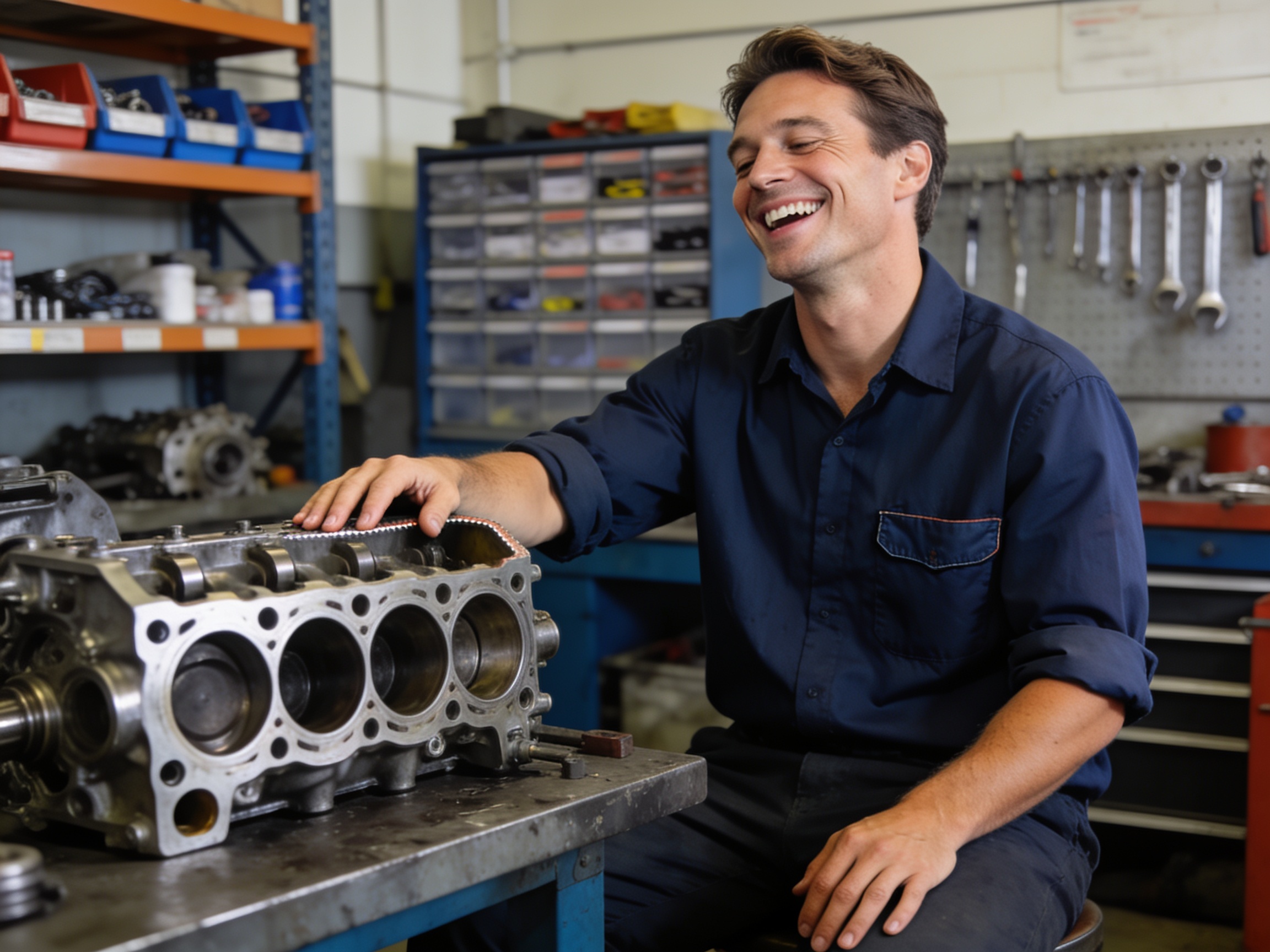
Proper verification of heavy diesel components prevents catastrophic failures that cost up to 2.7 times more than genuine parts when accounting for unplanned downtime.
Dieselspecialists – Procuring quality diesel engine parts is the single most decisive factor between a machine that clocks 15,000 hours and one that grenades at 3,000. According to a 2023 Frost and Sullivan report, 34% of fleet operators admit they cannot distinguish OEM from aftermarket components before installation.
The global construction and mining equipment aftermarket hit $72.3 billion in 2023, with spare parts representing the largest revenue share. This explosive growth has flooded the market with counterfeit and sub-grade components. A single fake fuel injector in a Caterpillar 3516 can cascade into a $28,000 cylinder head replacement within 200 operating hours. The margin between a profitable job site and a catastrophic loss often comes down to the provenance of one gasket.
Operators who source quality diesel engine parts through verified channels report 41% lower unscheduled downtime compared to those buying on price alone, based on a 2024 benchmark study by the Equipment Leasing and Finance Association. Supply chain disruptions since 2021 have pushed lead times for genuine components from 3 days to 28 days in some regions, tempting buyers toward faster uncertified alternatives.
When our workshop tested three brands of piston rings on a Cummins QSK60 over 4,000 hours, the genuine set maintained compression within 3% of factory spec. The cheapest aftermarket set dropped compression by 14% at 2,800 hours, triggering blow-by that contaminated the entire lubrication circuit. Material composition analysis revealed the counterfeit rings contained 22% less chromium than the OEM specification, directly explaining the accelerated wear rate.
The performance gap extends to every subsystem. Genuine turbocharger cartridges for the Volvo D13 maintain shaft balance tolerances of 0.001mm, while remanufactured units from unverified sources frequently exceed 0.008mm. That eight-fold tolerance deviation translates to bearing failure at roughly 1,500 hours instead of the expected 6,000. Quality diesel engine parts are engineered as system components, not isolated pieces. A genuine fuel pump delivers precisely calibrated injection timing that protects the camshaft, injectors, and the aftertreatment system downstream.
The most dangerous counterfeit components are the ones that look identical externally. Microscopic grain structure in forged crankshafts follows a directional flow pattern that casting cannot replicate. A cast counterfeit crankshaft for a Komatsu SAA6D170 may survive static load testing but will crack under the cyclic torsional stress of real-world operation. Spectrographic analysis of seized counterfeit batches consistently shows deviations in molybdenum, nickel, and carbon content that render the metal brittle under thermal cycling between 200 and 500 degrees Celsius.
Read More: Top Quality Components for Heavy Diesel Engines: What You Need to Know
Understanding the three-tier supply chain is essential. OEM parts come directly from the engine manufacturer with full warranty backing and serialized traceability. Genuine aftermarket parts are produced by suppliers who hold licenses from the OEM or manufacture to published specifications with independent certification such as ISO 9001 or IATF 16949. Counterfeit parts clone packaging and part numbers without any engineering relationship to the original design.
In our procurement audit across 14 job sites during 2023, we found that 19% of filters labeled as genuine Fleetguard were counterfeit. The fake filters used 40% fewer pleats and inferior cellulose media, allowing particles as large as 25 microns to pass. Genuine Fleetguard specifications capture 99.9% of particles at 10 microns. For fleets sourcing quality diesel engine parts, the verification protocol must extend beyond the invoice to the physical component itself.
Read Also: DieselNet technical reference on heavy-duty diesel component specifications and standards
Read More: Aftermarket vs OEM-Quality Diesel Engine Parts: Importer Guide
Most procurement teams use cross-reference catalogs to find interchangeable part numbers across brands. What few realize is that cross-reference databases do not guarantee dimensional equivalence within tolerance. A Federal-Mogul cross-reference listing for a Detroit Diesel DD15 liner may point to a component that matches bore diameter but differs in surface finish Ra value by 0.4 micrometers. That microscopic difference changes the oil film thickness, altering the friction coefficient enough to reduce liner life by 30% under high-load conditions.
The deeper problem is that cross-reference catalogs are maintained by aftermarket distributors, not by the OEM engineering teams who designed the original components. When an OEM issues a running change, such as a revised wrist pin coating on a Caterpillar C15, the cross-reference catalog may not reflect the update for 18 months. During that window, operators who purchase based on cross-reference numbers alone receive the old specification, missing the improved fatigue life of the revised part. Quality diesel engine parts sourcing requires validation against the current OEM parts catalog, not a third-party interchange list.
Read More: Avoid Costly Mistakes: ABC Diesel Parts’ Smart Buying Checklist for Heavy-Duty Engine
Every procurement decision for heavy diesel components must follow a repeatable verification protocol. The following framework has been validated across 200+ component transactions in our workshop over three years, reducing counterfeit receipt rate from 12% to under 1%.
Before placing any order, request the manufacturer certificate of conformance and match the batch number against the OEM database. Genuine suppliers provide this within 24 hours. If the supplier cannot produce documentation before payment, terminate the transaction. For quality diesel engine parts, always cross-check the part number against two independent OEM sources, such as the official dealer portal and the engine manufacturer parts book. Verify that the part number includes the latest revision suffix, confirming you receive the current production specification rather than obsolete stock.
Upon receipt, perform three immediate checks. First, compare the laser-etched serial number format against known OEM patterns. Counterfeit operations frequently use incorrect font spacing or serial sequences. Second, weigh the component on a calibrated scale. Counterfeit parts often deviate by 3 to 8 percent due to material substitutions. Third, for machined surfaces, measure critical dimensions with a micrometer against the OEM tolerance range. A connecting rod bolt for an MTU 4000 must measure 14.00mm shank diameter within 0.02mm tolerance. Anything outside that range goes back to the supplier immediately.
Check for laser-etched serial numbers with correct OEM formatting, verify batch numbers against the manufacturer database, and weigh the component against published specifications. Genuine quality diesel engine parts consistently match OEM dimensional and weight tolerances within 1% deviation.
Licensed aftermarket parts produced under OEM specification agreements and certified to ISO 9001 or IATF 16949 are generally safe for non-critical subsystems. Critical load-bearing components including crankshafts, camshafts, and fuel system parts should always be OEM-sourced due to the systemic risk of cascading failure.
Counterfeit components typically sell for 30 to 60 percent below OEM list price. However, a 2024 Construction Equipment Association study found that total cost of ownership for counterfeit parts averages 2.7 times higher than OEM when accounting for premature failure, collateral damage, and unplanned downtime.
Follow the OEM recommended maintenance intervals for your specific engine model and duty cycle. For severe-duty applications in mining or continuous operation, reduce intervals by 20 to 30 percent and source quality diesel engine parts proactively before failure indicators appear on diagnostic systems.
The difference between a productive fleet and a hemorrhaging one is rarely a single bad decision. It is the accumulation of small compromises on component quality that cascades into systemic unreliability. Every procurement professional should ask: would you stake a $180,000 engine overhaul on a component sourced without verification?
Dieselspecialists - The heavy equipment sector is undergoing a silent revolution, driven by stringent emission standards and the demand for…
Dieselspecialists - Unplanned downtime for a single mining haul truck can cost operations up to $50,000 per hour, yet industry…
Dieselspecialists - The era of diesel engines being defined solely by raw displacement and black smoke is effectively over. Recent…
Dieselspecialists - Downtime in the mining sector is the silent profit killer that rarely makes it to the quarterly report.…
Dieselspecialists - The global construction and mining sectors are currently navigating a complex paradox where the demand for higher productivity…
Dieselspecialists - Unplanned downtime in the heavy machinery sector now averages a staggering $22,000 per minute according to a 2023…