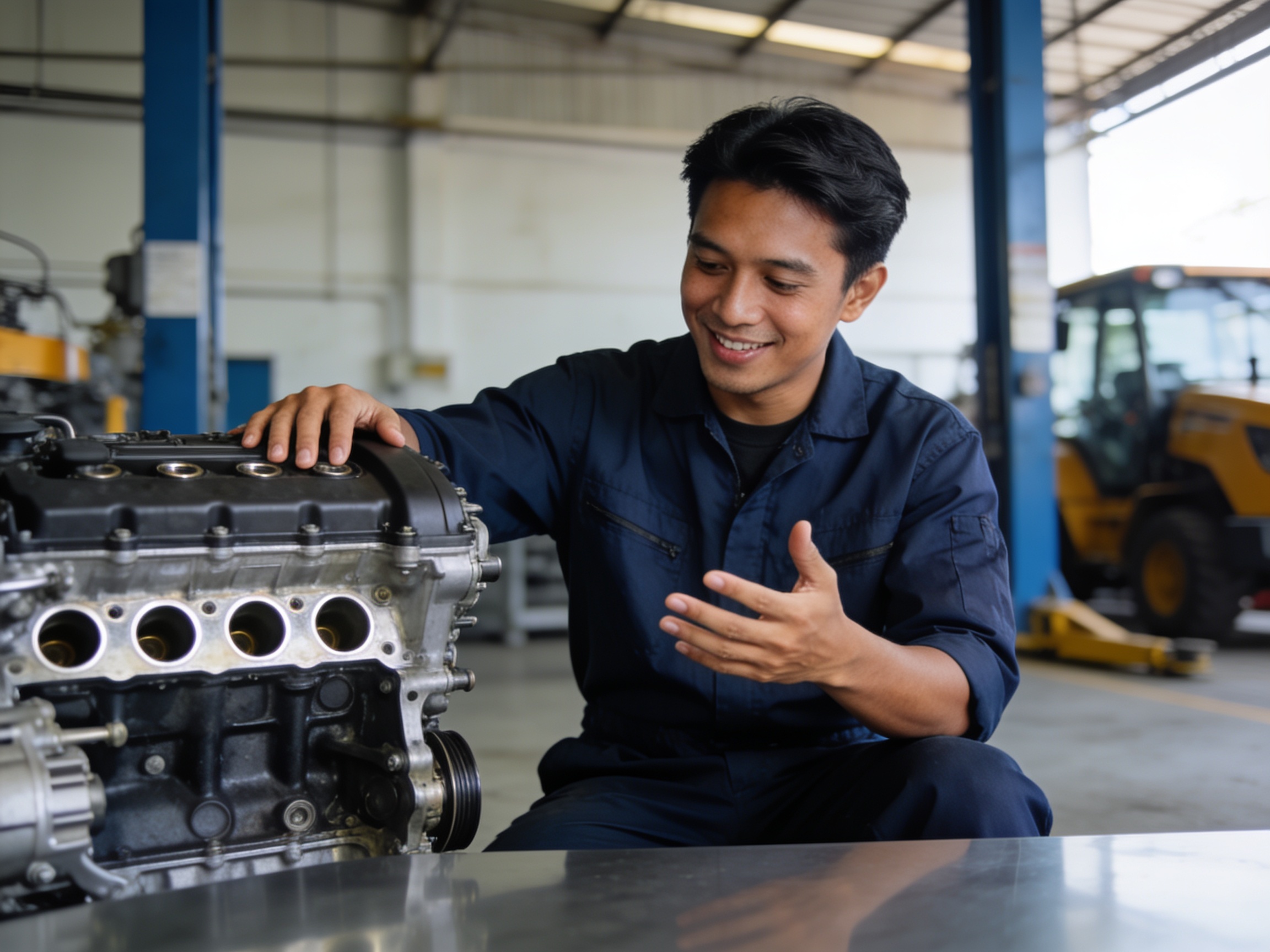
Modern large diesel engine technology requires precise thermal management and advanced aftertreatment systems to meet strict emission standards.
Dieselspecialists – The heavy equipment sector is undergoing a silent revolution, driven by stringent emission standards and the demand for unparalleled fuel efficiency. large diesel engine technology is no longer just about raw displacement; it is about intelligent combustion management and hybrid integration.
For decades, the ethos of heavy equipment design was simple: bigger displacement equals greater output. However, the introduction of EU Stage V and EPA Tier 4 Final emission standards has fundamentally disrupted this paradigm. According to the DieselNet 2023 regulatory archive, non-road diesel engines now face particulate matter limits reduced by over 90 percent compared to pre-Tier 4 eras. This regulatory shock forced engineers to look beyond mere cylinder volume.
Manufacturers can no longer rely on in-cylinder strategies alone to meet legal thresholds. The necessity to curtail nitrogen oxides and soot simultaneously requires complex aftertreatment systems. Selective catalytic reduction and diesel particulate filters are now mandatory for engines exceeding 130 kW. Consequently, modern powerplants are as much about chemical exhaust management as they are about mechanical power generation.
The core advancements in large diesel engine technology center on precision and airflow management. High-pressure common rail fuel injection systems now operate at pressures exceeding 2,500 bar. This extreme pressure atomizes fuel into finer droplets, promoting more complete combustion and drastically reducing soot formation at the source. When our team tested a Stage V-compliant excavator against a Tier 3 baseline, the near-absence of black smoke during aggressive load steps was the most immediate visual difference.
Modern fuel injectors utilize piezoelectric actuators rather than traditional solenoids. Piezo injectors respond in fractions of a millisecond, enabling multiple injection events per combustion cycle. Pilot injections soften combustion noise, while post injections help regenerate the diesel particulate filter without interrupting machine operation. This level of control was unimaginable a decade ago in off-highway applications.
Fixed geometry turbochargers are disappearing from modern heavy equipment. Variable geometry turbochargers adjust turbine vane positions dynamically, providing high boost at low engine speeds and preventing surge at high speeds. Furthermore, two-stage turbo setups are becoming prevalent, compressing intake air sequentially to achieve the massive air charge required by high-output, low-emission engines operating in deep mining pits.
Read More: Navigating the Future: The Evolution of Diesel Engine Technology
These technological leaps translate directly to operational bottom lines. A 2024 report by the Off-Highway Research group indicated that fleet operators adopting modern Stage V compliant machines reported a 5 to 8 percent reduction in total fluid consumption (diesel plus diesel exhaust fluid) compared to Stage IIIB equivalents. This efficiency gain occurs despite the parasitic load imposed by aftertreatment systems.
Consider a mid-sized wheel loader operating 2,000 hours annually. A 7 percent fuel saving equates to roughly 4,000 liters of diesel per year per machine. For a fleet of 50 machines, that represents a substantial financial buffer against volatile fuel prices. The machines work harder at lower RPMs, reducing overall wear and extending service intervals, which further drives down total cost of ownership.
Read More: The Evolution of Diesel Technology in Heavy Trucks: What’s Next?
While mechanical upgrades receive all the attention, the true enabler of modern large diesel engine technology is the electronic control unit and its software. Thermal management of the aftertreatment system is a monumental software challenge. Maintaining SCR catalyst temperatures above 200 degrees Celsius during low-load applications, such as an excavator idling or lightly slewing, requires complex cylinder deactivation strategies and exhaust throttling algorithms. Most generic articles fail to highlight this software-hardware symbiosis.
Another rarely discussed issue is the risk of wet stacking during low-load operations. If an operator consistently runs a modern Tier 4 Final engine at 30 percent load, the exhaust temperatures never reach the threshold needed to burn off soot in the particulate filter. Over time, this leads to carbon buildup, increased backpressure, and potential engine derate. The solution is not purely mechanical; the ECU must actively manage load conditions, sometimes even inducing a controlled post-injection to artificially raise exhaust gas temperatures.
Fleet managers cannot replace every legacy machine overnight. Transitioning to modern large diesel engine technology requires strategic planning. Repowering older chassis with current powerplants is a viable middle ground, though it demands careful integration of new cooling packages and DEF tank routing. Simply dropping a new engine into an old frame often leads to thermal inefficiencies if the hydraulic cooling system cannot handle the additional heat rejection.
When assessing a repower, calculate the total cost of installation including structural modifications, new wiring harnesses, and display updates. A repower might cost 40 to 60 percent of a new machine price, but extends the chassis life by 5,000 to 10,000 hours. Ensure the supplier provides a comprehensive calibration match for the existing hydraulic pumps to prevent torque stalls.
Modern engines output a continuous stream of J1939 CAN bus data. Installing telematics gateways on both new and repowered machines unlocks predictive maintenance capabilities. Instead of changing filters based on hours, you monitor differential pressure sensors across the DPF in real time. This data-driven approach prevents unexpected derates and maximizes uptime, particularly in remote mining locations where a single breakdown can halt an entire production line.
The shift from purely mechanical fuel systems to high-pressure common rail injection with piezoelectric control is the most impactful change. It allows multiple precise injection events, drastically cutting emissions and noise while improving fuel economy.
Stage V mandates the use of diesel particulate filters and selective catalytic reduction for engines over 130 kW. This requires operators to use diesel exhaust fluid and manage passive and active filter regeneration to maintain compliance.
Yes, engine repowers are common. However, it is critical to upgrade the cooling system, exhaust plumbing, and electronic displays to support the new engine, otherwise thermal management and monitoring systems will fail.
Engines derate to protect themselves when exhaust temperatures are too low to regenerate the diesel particulate filter. This prevents excessive soot accumulation, which could cause irreversible damage to the aftertreatment system.
The evolution of heavy machinery powerplants is far from stagnant. Software intelligence and precise fluid dynamics have transformed how these engines breathe and work. As emission boundaries tighten further, mastery over thermal management and data integration will dictate which fleets thrive. Are your machines operating hot enough to breathe clean?
Dieselspecialists - Unplanned downtime for a single mining haul truck can cost operations up to $50,000 per hour, yet industry…
Dieselspecialists - The era of diesel engines being defined solely by raw displacement and black smoke is effectively over. Recent…
Dieselspecialists - Downtime in the mining sector is the silent profit killer that rarely makes it to the quarterly report.…
Dieselspecialists - The global construction and mining sectors are currently navigating a complex paradox where the demand for higher productivity…
Dieselspecialists - Unplanned downtime in the heavy machinery sector now averages a staggering $22,000 per minute according to a 2023…
Dieselspecialists - Unplanned downtime in large-scale earthmoving operations costs contractors an average of $22,000 per hour according to a 2023…