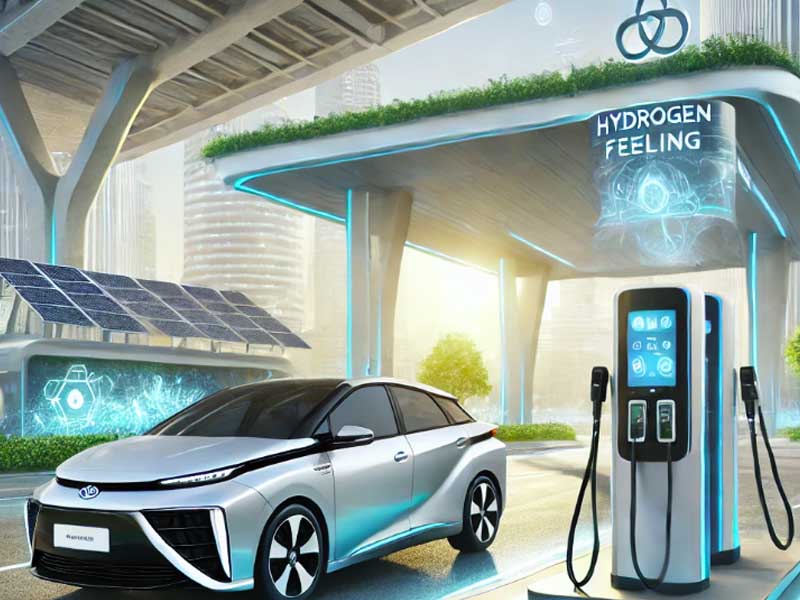
Dieselspecialists – Hydrogen Revolution is shaping the future of sustainable mobility, and Japan and South Korea are leading the charge. With increasing global concerns about carbon emissions and the limitations of battery-electric vehicles, hydrogen fuel cell technology has emerged as a promising alternative. Japan’s Toyota and South Korea’s Hyundai are at the forefront of this innovation, investing heavily in hydrogen-powered vehicles.
Toyota is set to test its Hiace hydrogen-electric model, showcasing its commitment to a future where hydrogen plays a key role in transportation. Meanwhile, Hyundai has announced the launch of INITIUM, a Fuel Cell Electric Vehicle (FCEV) model designed to redefine the automotive industry’s approach to clean energy. As these advancements take shape, hydrogen vehicles offer an efficient, eco-friendly alternative without the dependency on large battery systems.
The Hydrogen Revolution is gaining momentum thanks to significant investments from Japan and South Korea. The two nations have long been pioneers in alternative energy solutions, and their focus on hydrogen-powered vehicles signals a shift towards a cleaner automotive future. Toyota has been a leader in hydrogen technology, with its Mirai model being one of the first commercially available FCEVs. Hyundai, on the other hand, has invested in expanding its hydrogen infrastructure. Ensuring that its INITIUM model will be supported by an extensive refueling network.
“Double Edged: The Reality of Student Nightlife”
Beyond passenger cars, both countries are also pushing for hydrogen applications in commercial and public transportation. Hydrogen buses and trucks are being tested to reduce emissions in urban areas, further proving the viability of this technology. With government support and corporate investment, the Hydrogen Revolution is becoming more than just a concept it’s becoming a reality.
Hydrogen Revolution is not just about technological innovation; it is about transforming the way we think about transportation. As Japan and Korea continue to advance their hydrogen vehicle initiatives, the rest of the world is watching closely. Countries in Europe and North America are also exploring hydrogen solutions. But Japan and Korea remain the undisputed leaders in this space.
The advantages of hydrogen vehicles include faster refueling times. Longer driving ranges, and a reduced reliance on rare minerals required for lithium-ion batteries. However, challenges such as infrastructure expansion and production costs remain. Despite these obstacles, the commitment of Toyota, Hyundai, and their respective governments ensures that hydrogen-powered transportation will play a critical role in the future of mobility.
With continued innovation and investment. The Hydrogen Revolution is set to redefine the global automotive industry, offering a cleaner, more efficient alternative to traditional fossil fuels. As Japan and Korea lead the way, the world inches closer to a sustainable transportation future driven by hydrogen energy.
“From YOLO to YONO: Embracing Sustainability and Simplicity”
Dieselspecialists - Heavy‑duty construction firms are scrambling to select the right powerplant as demand for larger equipment surges, with 2023…
Dieselspecialists - Procuring quality diesel engine parts is the single most decisive factor between a machine that clocks 15,000 hours…
Dieselspecialists - The heavy equipment sector is undergoing a silent revolution, driven by stringent emission standards and the demand for…
Dieselspecialists - Unplanned downtime for a single mining haul truck can cost operations up to $50,000 per hour, yet industry…
Dieselspecialists - The era of diesel engines being defined solely by raw displacement and black smoke is effectively over. Recent…
Dieselspecialists - Downtime in the mining sector is the silent profit killer that rarely makes it to the quarterly report.…